
See a sample

A cited ancestor narrative, in full.

Below is a working demo of what we build. Every factual sentence is traced to a real record, a DNA match, or an ancient-DNA sample — with numbered footnotes you can check. These examples are fictional and clearly marked; your narrative is built from your own kit.

Illustrative examples — not real data
The cited narrative

DNA + records + ancient DNA, fused

Notice the footnote markers in the prose and the numbered citation list beneath each card — that is the source trail behind every line.

Illustrative — not real data

James McKinley

A paternal-line ancestor who settled the North Carolina backcountry, reconstructed step by step from a federal census, a colonial port book, a living DNA match, and an ancient genome — nothing guessed.

James was an established head of household in Rowan County, North Carolina, by about 1791 — Scots-Irish Presbyterian stock who came down the Great Wagon Road.[1] A generation earlier the line crossed the Atlantic: an ancestor departed Belfast in 1738 aboard the George and Anne.[2] A living descendant in Ballymena, County Antrim shares a 187 cM segment with your kit — a named, consented match that anchors the Ulster origin, not an estimate.[3] The direct paternal line carries Y-haplogroup R-L21, the dominant Atlantic-Celtic paternal lineage of Ireland and Britain.[4] That same R-L21 line turns up in the Rathlin Island ancient genome off the Antrim coast — a Bronze Age burial dated to roughly 2000 BCE, present on the island some four thousand years before the ship manifest.[5]

Illustrative federal census page showing James McKinley of Rowan County, North Carolina — a synthetic sample, not a real historical document.
Source verifiedIllustrative1800 U.S. Federal Census, Rowan County, NC (illustrative)
  1. [1]1800 U.S. Federal Census, Rowan County, NC
  2. [2]PRONI Belfast Port Books, 1738 — George and AnneView source
  3. [3]DNA match — 187 cM segment, Ballymena, Co. Antrim (consented)View source
  4. [4]Y-haplogroup R-L21 (Atlantic-Celtic paternal lineage)
  5. [5]Rathlin Island ancient genome, Ireland ~2000 BCE (Cassidy et al. 2016, Nature)View source

Continue this line back four more generations.

Unlock with your kit
Illustrative — not real data

Giuseppe Marino

A paternal-line ancestor who came through Ellis Island, traced through a ship manifest, a federal census, a Y-DNA haplogroup, and a living cousin match — every claim sourced.

Giuseppe arrived at the Port of New York in 1903, recorded on the manifest of the SS Sicilia out of Naples.[1] Two years later he appears as a stonemason in the Brooklyn enumeration of the 1905 New York State census.[2] His direct paternal line carries Y-haplogroup J-M172, a lineage common across the central Mediterranean.[3] A living descendant in Salerno shares 96 cM across 5 segments with your kit, consistent with a fourth-cousin relationship.[4]

Illustrative passenger manifest page showing Giuseppe Marino arriving at the Port of New York — a synthetic sample, not a real historical document.
Source verifiedIllustrativeEllis Island Passenger Manifest, 1903 (illustrative)
  1. [1]Ellis Island Passenger Manifest, SS Sicilia, 1903
  2. [2]1905 New York State Census, Kings County (Brooklyn)
  3. [3]Y-haplogroup J-M172 (central Mediterranean paternal lineage)
  4. [4]DNA match — 96 cM / 5 segments (4C), SalernoView source

Continue this line back four more generations.

Unlock with your kit

This is an illustrative composite route built from real record types and real ancient-DNA studies. Your route is built the same way — from your DNA.

Source-verified proof

We show the record, not just the claim

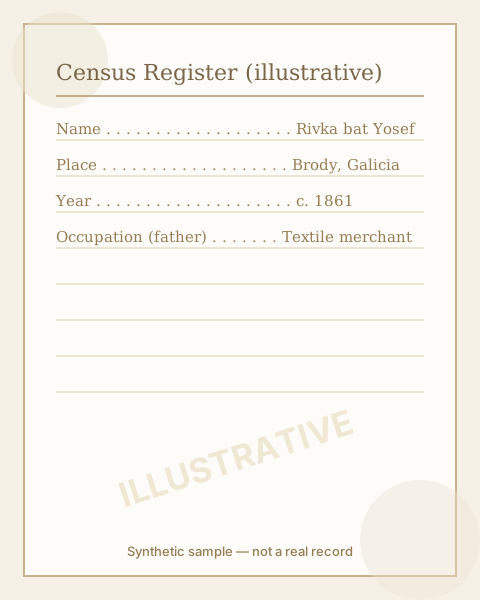
Each cited record links to a source-verified image — the document behind the claim, not just the claim itself.

Illustrative federal census page showing James McKinley of Rowan County, North Carolina — a synthetic sample, not a real historical document.
Source verifiedIllustrative1800 U.S. Federal Census, Rowan County, NC (illustrative)

This is a sample

Claim your free kit to get yours

Your first kit is free, no card. We build a narrative like these from your own DNA, records, and ancient-DNA matches — every line sourced.